Food Apartheid:
Limited Access to Healthy Food
Project Regeneration defines food apartheid as “a system of segregation that divides those with access to an abundance of nutritious food and those who have been denied that access due ot systemic injustice.(1)”
“Perhaps the best measure of whether someone who lives far from a grocery store faces obstacles to accessing affordable and nutritious food is whether or not he or she has a car. Access to a car allows people to leave the food desert and shop at supermarkets and large grocery stores outside of their neighborhoods.⁶”
Food apartheid in St. Louis is largely due to two factors: (1) there are few grocery stores and markets with fresh food in majority-black parts of the City; and (2) it is difficult for people to reach more distant stores because many do not own cars and are poorly served by public transportation.
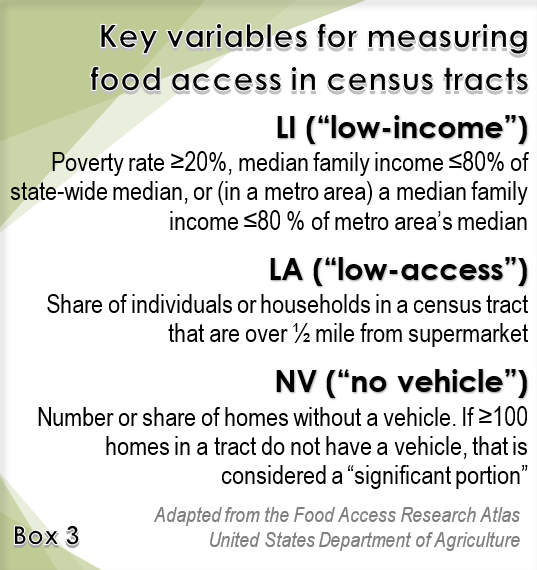
Food apartheid can be measured using three criteria: income, proximity to grocery stores, and vehicle ownership.
Using these criteria, we can label a census tract as “low-income, low-access, no vehicle",” or “LI-LA-NV.” LI-LA-NV census tracts are those in which a significant portion of the population have low access to healthy foods.
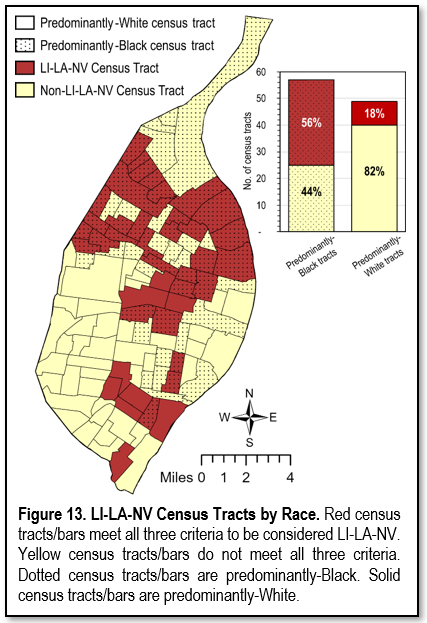
As shown in the figure to the left, most of the City’s LI-LA-NV census tracts have a predominantly-Black population.
In fact, of the 41 LI-LA-NV census tracts spread throughout St. Louis, 32 are predominantly-Black, with the remainder being predominantly-White. In other words, 78% of the City’s census tracts that can be considered “food deserts” have a predominantly-Black population.
Although public transportation can potentially increase mobility in residential areas with low vehicle availability, the St. Louis Metro (“Metro”) transit system prioritizes commercial areas over residential areas. When Metro released its first long-range plan in 2010, it noted that focus group participants identified expansion of services into North and South City as top priorities.⁸
Unfortunatley, plans for a north-to-south MetroLink Green Line were shuttered in 2025. (source: https://www.stlpr.org/economy-business/2025-09-24/st-louis-cancels-north-south-metrolink-expansion-project)
Why Access to Healthy Food Access Matters
“Access to healthy food is associated with lower risk for obesity and other diet-related chronic diseases.”¹³
Black St. Louisans have less access to healthy food and higher rates of diet-related chronic diseases than whites.
“In St. Louis City, 38% of African American adults are obese” compared to 27% of white City residents.¹⁴ In addition, “14% of African Americans have been diagnosed with diabetes compared with 11% of whites.”¹⁵ Furthermore, “for each chronic disease type, African Americans have a higher rate of death compared to whites.”¹⁶
Community Spotlights
Tosha Phonix, Food Justice Organizer
Tosha Phonix, Food Justice Organizer at the Missouri Coalition for the Environment, highlights the hard work and potential of urban growers in St. Louis. Tosha works with about 25 growers in North City, North County, and the Metro East. She helps them find ways to access land, establish farms, and create valueadded products from what they grow. According to Tosha, “Food justice is not like any other social activism you’ve seen—it takes into account all social ills.”

As Tosha notes, “there is food in these communities, it’s just not anything worth eating.” Fast food restaurants and corner stores alone do not providethe whole, nutritious foods that make up a healthy diet. In 2011, a local partnership started the St. Louis Healthy Corner Store Project to change this, but the project has faced resistance in many communities because corner stores have a reputation for being hubs of illegal activity. There also are concerns about cleanliness, and the produce offered at corner stores often is overpriced or expired. “You can bring fresh produce into corner stores but if the community doesn’t have a good relationship with the store, they’re not gonna come in and buy it.”
Looking at the maps showing food access in St. Louis City, “you would think that no one is doing the work, but that’s not true. If people aren’t in tune, they’ll never know about city growers, but you have amazing people in your community doing amazing things.” Local growers don’t just provide healthy food; they encourage communities to take ownership of their neighborhood by making them safer and more self-sufficient.
Tosha points out that while local growers are bringing healthy food to some City residents, it’s very hard for others to get to grocery stores. “Some buses only come once an hour, and you have to time your trip very carefully to catch the return bus. It’s especially difficult when you work during the day. It takes a lot of time to go grocery shopping by bus, and the buses run less frequently in the evenings and on weekends. The whole system is jacked up and inconvenient.”
Heru Urban Farming
Tyrean Lewis is the founder and president of Heru Urban Farming and Garden. Its mission is to provide quality organic food and herbal supply for under-resourced and health-stricken areas within urban communities. The project started in 2018 with three lots in the Kingsway West neighborhood in Ward 1, where 33% of the population lives below the poverty line. Most of the residents are elderly and lack reliable transportation. The community was excited to learn about and help out with the urban farm. This pilot farm was so successful that Heru Urban Farming acquired four more lots in the College Hill neighborhood in Ward 3, where 41% of the residents live below the poverty line. Tyrean is excited to see what the second year in operation will bring because the first exceeded expectations.
Learn more about Heru Urban Farming at https://heruurbanfarming.com/
Tonja Bulley’s Transportation Struggles
Tonja Bulley is a resident of the Greater Ville neighborhood in St. Louis City. She grew up in the City then moved out to the County to raise her children. She relocated back to the City because rent is much more affordable. Ms. Bulley cares for her aunt who suffers from Alzheimer’s disease and works as a home health aide.
Recently, Ms. Bulley had to start using public transportation because she does not have a vehicle. What was previously a twenty-minute car ride to work now takes over an hour and requires three separate buses. Bus fare is costly and adds up. Often, Ms. Bulley asks family and friends for a ride but feels burdensome. However, she would rather catch a ride to the grocery store than shop at a local corner store. Ms. Bulley emphasized the high-priced foods and poor treatment of customers by management.
References
¹ https://regeneration.org/nexus/food-apartheid
² The Guardian, Food Apartheid: the Root of the Problem with America’s Groceries, available at https://www.theguardian.com/society/2018/may/15/food-apartheid-food-deserts-racism-inequality-america-karen-washington-interview.
³ U.S. Department of Agriculture, Economic Research Service, Food Access Research Atlas Documentation, available at https://www.ers.usda.gov/data-products/food-access-research-atlas/ documentation/. “Low-income” is defined as having a poverty rate of 20 percent or greater, a median family income less than or equal to 80 percent of the state-wide median, or – in a metropolitan area – a median family income less than or equal to 80 percent of the metropolitan area’s median. “Significant share” is defined as at least 500 people or 33 percent of the population.
⁴ Prepared by the Interdisciplinary Environmental Clinic. Data Sources: U.S, Department of Agriculture, Economic Research Service, Food Access Research Atlas Data Download 2015, available at https://www.ers.usda.gov/webdocs/DataFiles/80591/DataDownload2015.xlsx?v=0; Missouri Spatial Data Information Service, 2010 U.S. Census Tract Data, available at http://msdis-archive.missouri.edu/archive/Missouri_Vector_Data/USCensus2010/tract10.zip.
⁵ U.S. Department of Agriculture, Economic Research Service, Food Access Research Atlas Documentation, available at https://www.ers.usda.gov/data-products/food-access-research-atlas/documentation/. “Significant number” is defined as at least 100 households.
⁶ Michele Ver Ploeg, Access to Affordable, Nutritious Food Is Limited in “Food Deserts,” Amber Waves (Mar. 1, 2010), available at www.ers.usda.gov/amber-waves/2010/march/access-to-affordable-nutritious-food-is-limited-in-food-deserts/.
⁷ Prepared by the Interdisciplinary Environmental Clinic. Data Sources: U.S. Department of Agriculture, Economic Research Service, Food Access Research Atlas Data Download 2015, available at https://www.ers.usda.gov/webdocs/DataFiles/80591/DataDownload2015.xlsx?v=0; Missouri Spatial Data available at http://msdis-archive.missouri.edu/archive/Missouri_Vector_Data/USCensus2010/tract10.zip
⁸ Metro, Moving Transit Forward: St. Louis Regional Long-Range Transit Plan, p. 34, available at http://www.metrostlouis.org/wp-content/uploads/2016/03/moving-transit-forward-plan.pdf. The report identifies “Downtown St. Louis through north city and into north St. Louis County” and “Downtown St. Louis through south city and into south St. Louis County” as two of five expansion priorities.
⁹ Matthew Hibbard, North County Transit Center Makes Its Inaugural Debut, Metro (Mar. 14, 2016), available at https://www.metrostlouis.org/nextstop/north-county-transit-center-makes-itsinaugural-debut/.
¹⁰ Citizens for Modern Transit, 2018 Annual Report, Transit: Benefits Beyond the Ride, p. 3, available at https://cmt-stl.org/app/uploads/2014/11/CMT-Annual-Report18web-only.pdf.
¹¹ Urban Harvest STL, About Us, available at www.urbanharveststl.org/about-us; Good Life Growing, Home, available at https://www.goodlifegrowing.com/.
¹² St. Louis Metro Market, About Us, available at https://www.stlmetromarket.com/about.
¹³ Sarah Treuhaft and Allison Karpyn, The Grocery Gap: Who Has Access to Healthy Food and Why It Matters, PolicyLink and The Food Trust (2010), p. 8, available at http://thefoodtrust.org/uploads/media_items/grocerygap.original.pdf.
¹⁴ For the Sake of All, p. 48.
¹⁵ Id.
¹⁶ Id.