Vacant Properties
St. Louis has an unusually high number of vacant properties, primarily in North City and in the southeastern portions of the City.¹ More than 40% of the City’s census tracts have at least 10% vacant properties, ranking St. Louis as one of the worst cities in the nation for “hypervacancy.”² The situation has gotten progressively worse in recent decades.³ The City’s vacant properties, which include both abandoned structures and vacant land, impose heavy burdens on nearby residents, from decreased property values to rampant illegal dumping.
Unlike the decades of reinvestment that benefitted the City’s majority-white central corridor, majority-black areas like North City have been left to decline through benign neglect.⁴ Among the forces contributing to vacancy are disinvestment in majority-black and low-income neighborhoods, and other discriminatory public policies and practices, including “redlining and predatory or negligent investors.”⁵
As shown in the figure to the left, vacant properties are overwhelmingly located in majority-black areas. As of August 2025, 87% of the City’s 21,000 + vacant properties are in majority-Black neighborhoods, with just three of those neighborhoods— Wells Goodfellow, Jeff Vanderlou, and Greater Ville— containing about 25% of all the vacant properties in the City.⁷ Each of these neighborhoods is more than 96% black.⁸
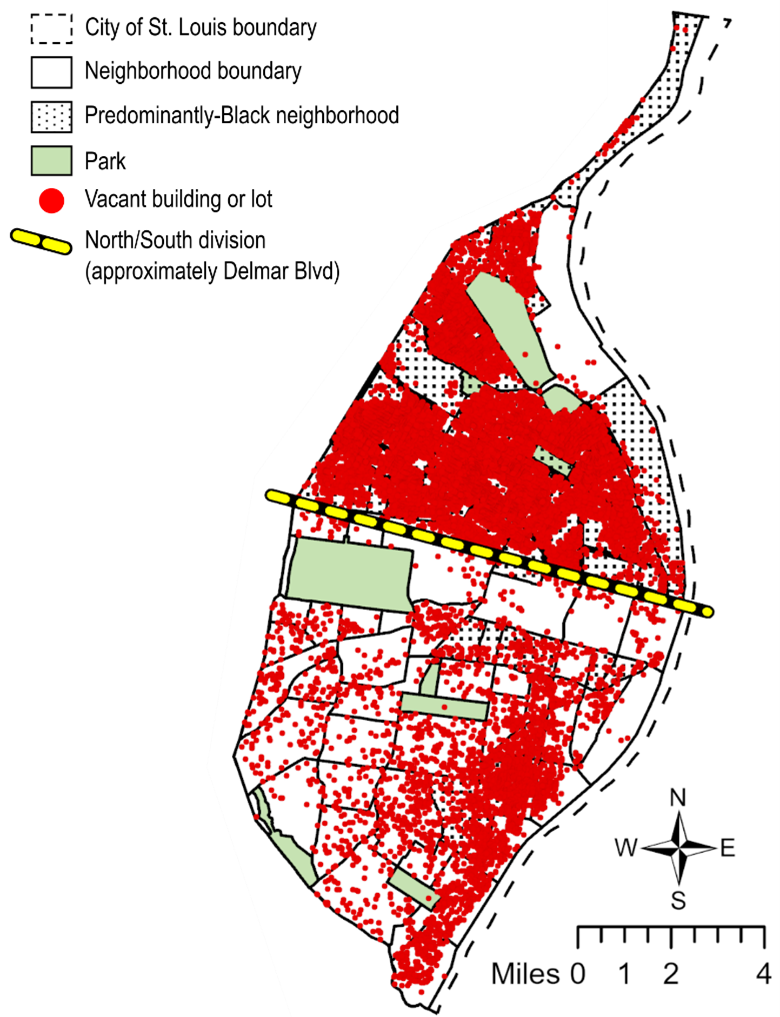
VACANT PROPERTIES IN ST. LOUIS⁹When a neighborhood’s vacancy rate exceeds 20%, it becomes “hypervacant.” St. Louis is home to 27 hypervacant neighborhoods. All of the City’s hypervacant neighborhoods are majority-Black, with each neighborhood having a median Black population share of 96%.
As shown below, all but hypervacant neighborhood is located in North St. Louis.
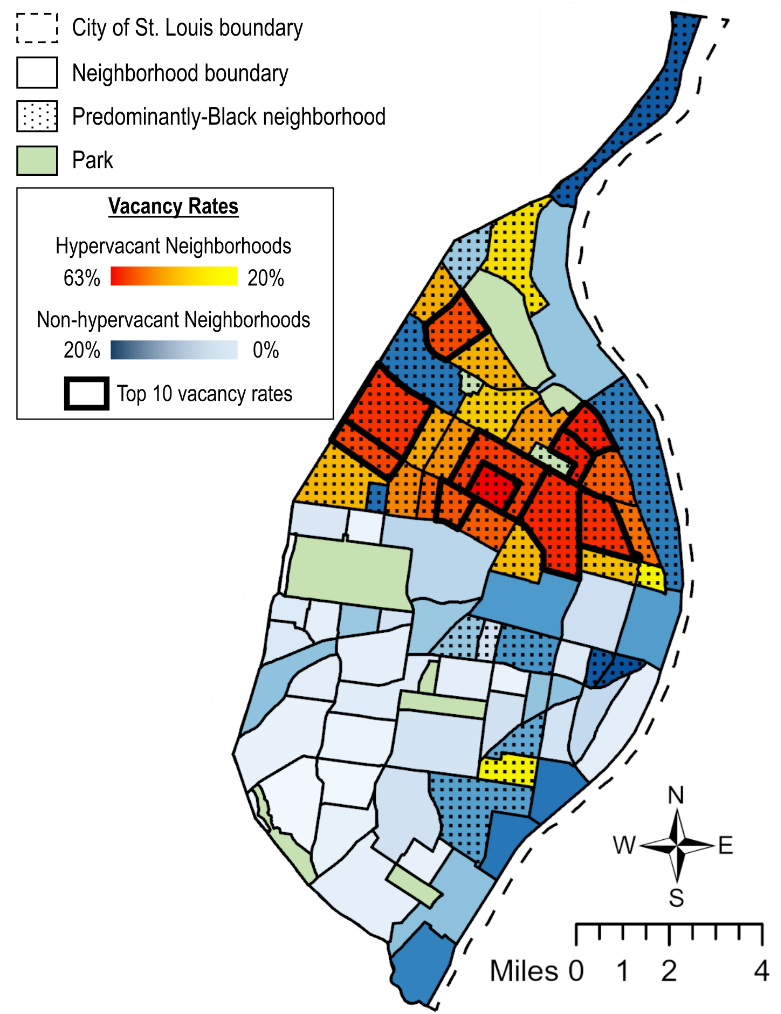
North St. Louis is also home to the Top 10 most hypervacant neighborhoods in the City. These neighborhoods contain almost half of the City’s vacant properties, despite covering only about 10% of the City’s land area.
They are all over 90% Black.
Dangers Posed by Vacant Properties
Vacant properties impose physical, economic, and emotinoal harms.
Vacant properties are a breeding ground for unsafe, and sometimes criminal activities - in some cases, leading to traumatic instances of suffering and death.¹²
Additionally, vacant properties demoralize neighborhood residents while draining limited taxpayer dollars and driving down property values.¹³,¹⁴
Abandoned buildings may contain asbestos in insulation and in floor and ceiling tiles, lead-based paint, and, in the case of commercial or industrial buildings, oil, PCBs, or other chemicals.¹⁰ As discussed in the Air Pollution section, demolition can expose residents to these harmful pollutants.¹¹
Long-abandoned buildings are also likely to accumulate dangerous mold, especially in humid areas.
References
¹ Dana Malkus et al., A Guide to Understanding and Addressing Vacant Property in the City of St. Louis, St. louis University School of Law, RISE, and Tower Grove Neighborhoods CDC (2018), p. 5, available for download at http://www.risestl.org/what-we-do/public-documents/vacancy-guide/.
² Allan Mallach, The Empty House Next Door: Understanding and Reducing Vacancy and Hypervacancy in the United States, Lincoln Institute of Land Policy (2018), p. 29, available for download at https://www.lincolninst.edu/publications/policy-focus-reports/empty-house-next-door.
³ Id., p. 32.
⁴ Trap of Triage, p. 163; The Use of Federal Housing and Economic Development Funds in St. Louis: From “Team 4” into the Future, Hearing before the Subcommittee on Housing and Community Opportunity, of the House Committee on Financial Services, 110th Cong. 77-81 (2008) (statement of Jamala Rogers, Chairperson of the Organization for Black Struggle).
⁵ Dana Malkus et al., A Guide to Understanding and Addressing Vacant Property in the City of St. Louis, St. Louis University School of Law, RISE, and Tower Grove Neighborhoods CDC (2018), p. 5, available for download at http://www.risestl.org/what-we-do/public-documents/vacancy-guide/.
⁶ STL Vacancy, Vacancy Portal: Interactive Vacancy Map, available at https://www.stlvacancy.com/map.html. Citywide dataset downloaded and analyzed by the Interdisciplinary Environmental Clinic
⁷ STL Vacancy, Vacancy Portal: All Metrics, available at https://www.stlvacancy.com/metrics.html
⁸ City of St. Louis, Census Results (2010), Neighborhood Results, available at http://dynamic.stlouis-mo.gov/census/neighborhood.cfm.
⁹ Prepared by the Interdisciplinary Environmental Clinic. Data Sources: STL Vacancy, Vacancy Portal: Interactive Vacancy Map, available at https://www.stlvacancy.com/map.html. Vacancy data retrieved in August 2025. City of St. Louis, Census Results (2010), Neighborhood Results, available at http://dynamic.stlouis-mo.gov/census/neighborhood.cfm.
¹⁰ Institute for Tribal Environmental Professionals, Abandoned/Unsafe Buildings and Structures, available at http://www7.nau.edu/itep/main/HazSubMap/twrap_HzSubMap_AbanBldgs.asp.
¹¹ EPA, On the Road to Reuse: Residential Demolition Bid Specification Development Tool (Sept. 2013), pp. 9-14, available at https://www.epa.gov/sites/production/files/2013-09/documents/road-to-reuse-residential-demolition-bid-specification-201309.pdf; Felicia Rabito et al., The association between demolition activity and children’s blood lead levels, Environmental Research 103:345-351 (2007), pp. 349-50.
¹² Vacancy Letter from Sundy Whiteside, President of the Board of St. Louis Association of Community Organizations, available at http://slaco-mo.org/sundy-whiteside-vacancy-letter/.
¹³ Id.
¹⁴ Id.