Lead Poisoning
Although the City of St. Louis started prioritizing childhood lead poisoning in the early 1970s, and various programs and funding commitments have come and gone in the nearly 50 years since,¹ this preventable yet devastating problem persists today.²
Lead exposure predominantly harms the City’s black children, who accounted for more than 70% of children found to suffer from lead poisoning in 2016.³
As shown in the figure to the right, majority-Black zip codes exhibit higher rates of children with elevated blood lead levels than majority-White zip codes.
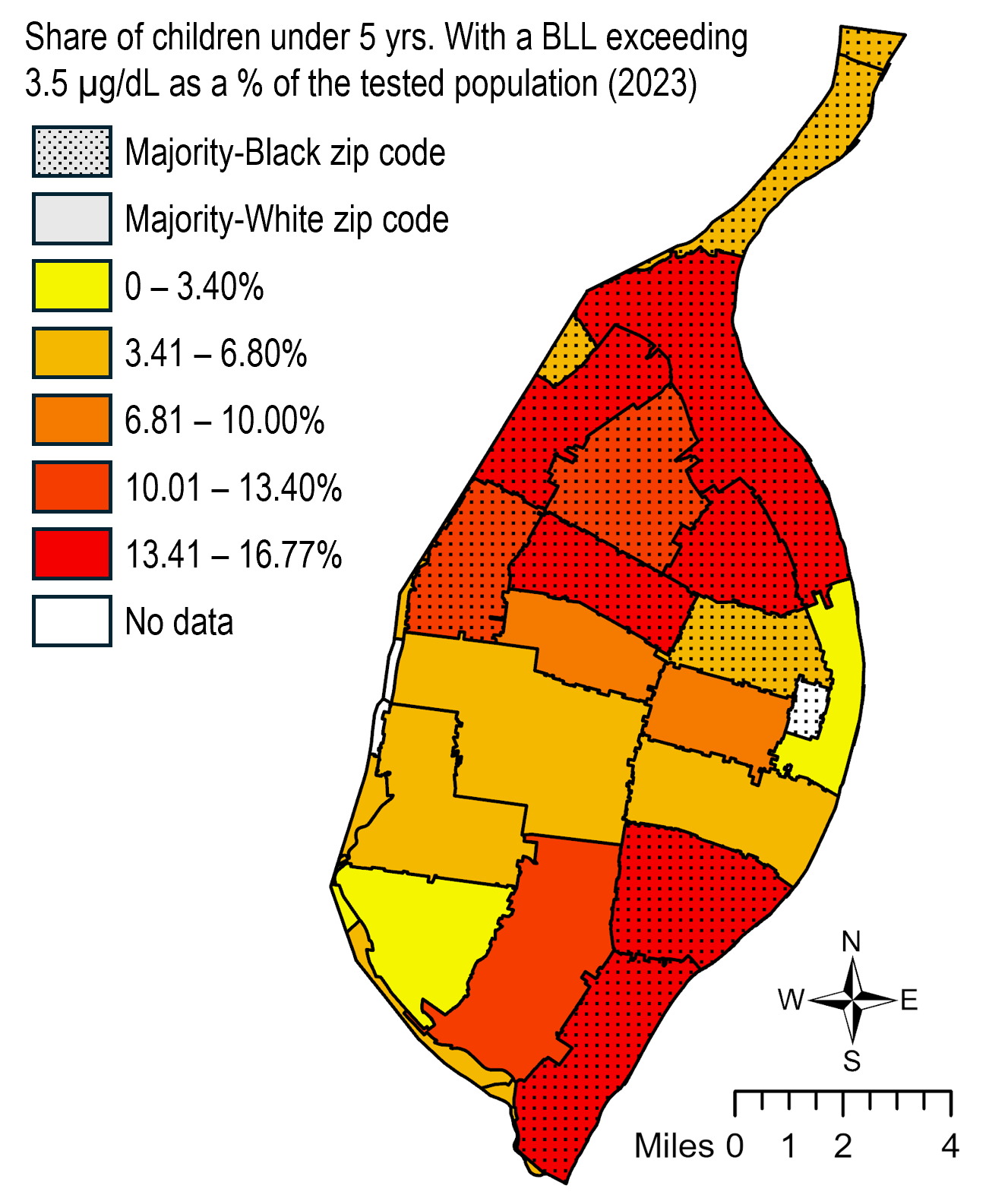
Children under 5 yrs of age with blood lead levels (BLLs) exceeding 3.5 µg/dL (2023).⁴ Our analysis indicates that in 2023, the median majority-Black zip code had a childhood lead poisoning rate of 13% – eight percentage points higher than that for the median majority-White zip code.
Median share of children with a BLL over 3.5 µg/dL as a percent of tested population in St. Louis City zip codes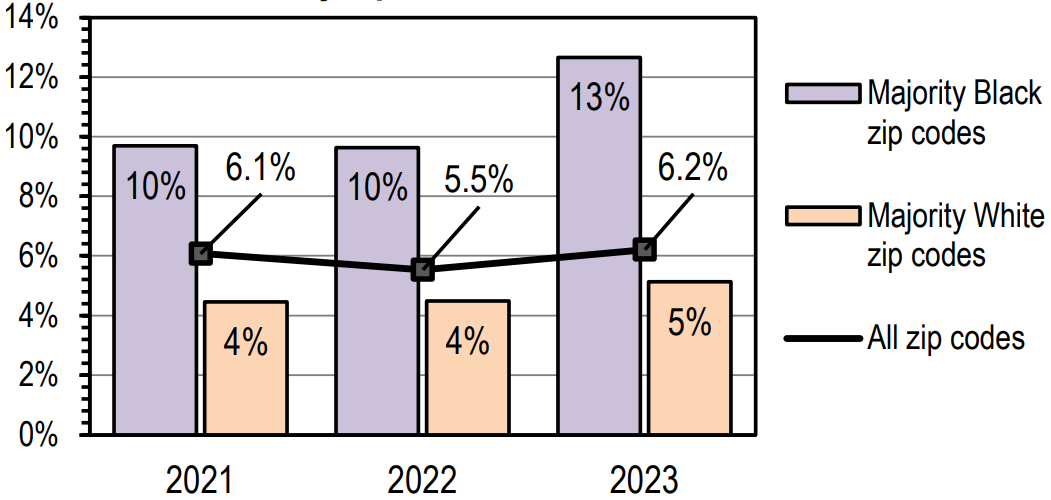
“Some Americans face a ‘triple whammy’ of increased risk based on poverty, race, and place. Evidence dating back to the 1970s has shown that lead poisoning rates are higher in inner cities and low-income and minority neighborhoods than in white, affluent, and suburban neighborhoods. … [G] overnment-supported suburban development and racial segregation after World War II contributed to lead poisoning by concentrating minority families in substandard urban housing. … [D]iscriminatory government policies effectively excluded minority families from buying homes in suburban neighborhoods, leaving them trapped in cities, where a vicious cycle of deterioration and disinvestment exacerbated lead hazards.”¹⁷
The Dangers of Lead Poisoning
There is no safe level of lead exposure.¹⁸
Childhood lead poisoning can cause permanent damage to the brain and nervous system, make it more difficult to learn and pay attention, and slow a child’s growth and development.²⁰ Lead poisoning can also cause learning disabilities, behavioral and emotional problems, and aggression, resulting in increased school drop-out rates, suspensions, and delinquency as well as criminal activity and violence.²¹ Children are most likely to get lead poisoning when lead from household paint gets into household dust, the dust gets on children’s hands, toys, or other objects, and children place those things in their mouths.²² Because lead poisoning has no obvious symptoms, a blood test is needed to determine whether a child is suffering from lead poisoning.²³
Updates to the lead testing landscape
There have been important changes to the way the U.S. and Missouri tackle childhood lead poisoning.
Oct 2021: the CDC decreased their blood lead reference value (BLRV) from 5.0 to 3.5 µg/dL.
Aug 28, 2022: Missouri passes the Get the Lead Out of School Drinking Water Act (Mo. Rev. Stat. 160.077), establishing a drinking water standard for lead of 5 ppb for all Missouri schools and early childhood education programs receiving state funding
August 2023: HB402 expands lead screening requirements for children in Missouri, requiring all children under 6 years of age to receive a lead risk questionnaire with optional blood lead testing at no cost.
For more information about these changes, see the full report.
References
¹ William L. Kincaid, Short History of Lead Poisoning in St. Louis, MO: Partnering to Shift into Primary Prevention (Oct. 2006), available at https://www.cdc.gov/nceh/lead/ACCLPP/October2006/ Attachment%201%20-%20Kincaid%20-%20LeadHistoryOct%202006final.pdf; Lead Safe St. Louis Data, available at https://www.mayorslay.com/sites/default/files//campaign/lit/ LeadSafeStLouissummary1212.pdf; 2017 Lead Safe St. Louis Documentary Part 1: Lead Safe Children, available at https://www.stlouis-mo.gov/government/departments/health/media/stl-tvlead-safe.cfm
² City of St. Louis Department of Health, Childhood Lead Poisoning in St. Louis City (2018), p. 1, available at https://www.stlouis-mo.gov/government/departments/health/documents/upload/2018- Lead-Poisoning-Report-8-15-18-1-3.pdf (“2018 Childhood Lead Poisoning in St. Louis City”). When this report refers to “childhood lead poisoning” or “elevated blood lead levels,” it means 5 micrograms per deciliter or above, unless the previous level of 10 micrograms per deciliter is specifically noted. In 2012, the U.S. Centers for Disease Control (CDC) lowered its measure for elevated blood lead level from 10 to 5 micrograms per deciliter. See CDC, Blood Lead Levels in Children, available at https://www.cdc.gov/nceh/lead/acclpp/lead_levels_in_children_fact_sheet.pdf.
³ 2018 Childhood Lead Poisoning in St. Louis City, p. 12
⁴ Prepared by the Interdisciplinary Environmental Clinic. Data Sources: 2018 Childhood Lead Poisoning in St. Louis City, p. 9; City of St. Louis, Census Results (2010), Ward Results (2011 Boundaries), available at http://dynamic.stlouis-mo.gov/census/ward11.cfm.
⁵ 2018 Childhood Lead Poisoning in St. Louis City, p. 1.
⁶ For the period July 1, 2016 through June 30, 2017, 3.53% of Missouri children who were tested had blood lead levels at or above 5 micrograms per deciliter, compared with 7.19% of St. Louis City children. Missouri Department of Health and Senior Services, Missouri Childhood Lead Poisoning Prevention Program Annual Report for Fiscal Year 2017, p. 10, available at https://health.mo.gov/living/environment/lead/pdf/annual-report-fy2017.pdf.
⁷ 2018 Childhood Lead Poisoning in St. Louis City, p. 13.
⁸ CDC, Lead Prevention Tips, available at https://www.cdc.gov/nceh/lead/tips.htm
⁹ 2018 Childhood Lead Poisoning in St. Louis, p. 13.
¹⁰ Id., p. 9.
¹¹ Id., p. 14.
¹² Id., p. 13.
¹³ See Figure 1.1
¹⁴ 2018 Childhood Lead Poisoning in St. Louis, p. 17.
¹⁵ 2018 Childhood Lead Poisoning in St. Louis, p. 15.
¹⁶ Id., pp. 12, 14. See also the next endnote below
¹⁷ Leif Fredrickson, The surprising link between postwar suburban development and today’s inner-city lead poisoning, The Conversation (Feb. 25, 2016), available at https://theconversation.com/the-surprising-link-between-postwar-suburban-development-and-todays-inner-city-lead-poisoning-54453.
¹⁸ CDC, Lead, available at https://www.cdc.gov/nceh/lead/default.htm.
²⁰ CDC, Lead Poisoning: Know the Facts, available at https://www.cdc.gov/nceh/lead/tools/know_the_facts.pdf.
²¹ Equity Indicators Report, p. 39; National Institutes of Health, Lead in kids’ blood linked with behavioral and emotional problems (June 30, 2014), available at https://www.nih.gov/news-events/news-releases/lead-kids-blood-linked-behavioral-emotional-problems; Lead Safe Illinois, Lead Poisoning, Behavior Problems, and Violence, available at http://www.leadsafeillinois.org/uploads/documents/FactSheetDelinquencyandCriminalBehavor.pdf.
²² CDC, Lead Poisoning: Know the Facts, available at https://www.cdc.gov/nceh/lead/tools/know_the_facts.pdf.
²³ Id.